UBI Is a Lie: How Tech Oligarchs Plan to Replace You—Then Pay You to Be Quiet
Updated: Sep 25
For generations, the rhythm of American life has been a rhythm of work. From the truck stops ruled by truckers to the aisles of supermarkets, from young college alumni climbing the corporate ranks to doctors interpreting complex diagnoses — these are not just jobs about checks. They're about identity, potential, and the shared beat of a nation.
But a new player has entered the picture: artificial intelligence. A product once the province of science fiction, AI has emerged rapidly, and its trace can be found in nearly every aspect of the American workplace. Its promise is efficiency and scale. Its risk? A redefinition — or elimination — of the jobs that have long defined the American dream.
Let's examine what that future holds, and why it's significant not just for its economic purposes, but as a matter of public health.
The Long Haul: AI and the Future of Trucking
Ask anyone to name the backbone of the American economy, and you’ll often hear one answer more than others : truckers. These are the people who keep shelves stocked, construction materials moving, and supply chains alive. Yet, the familiar sight of a long-haul driver on the freeway may soon become a relic of the past.
Self-driving technology has progressed faster than most anticipated. Companies like Waymo, Tesla, and Aurora are testing driverless trucks capable of navigating highways with minimal or no human intervention. These AI-powered rigs don’t need rest, don’t suffer fatigue, and can operate around the clock. It is a tempting equation for logistics companies chasing profit and efficiency. This is an incredibly realistic possibility in the next 15 years. In most urban areas around the country, driverless cars are becoming a more common sight by the day. It’s only a matter of time until the truck idea is scaled and put into fruition.
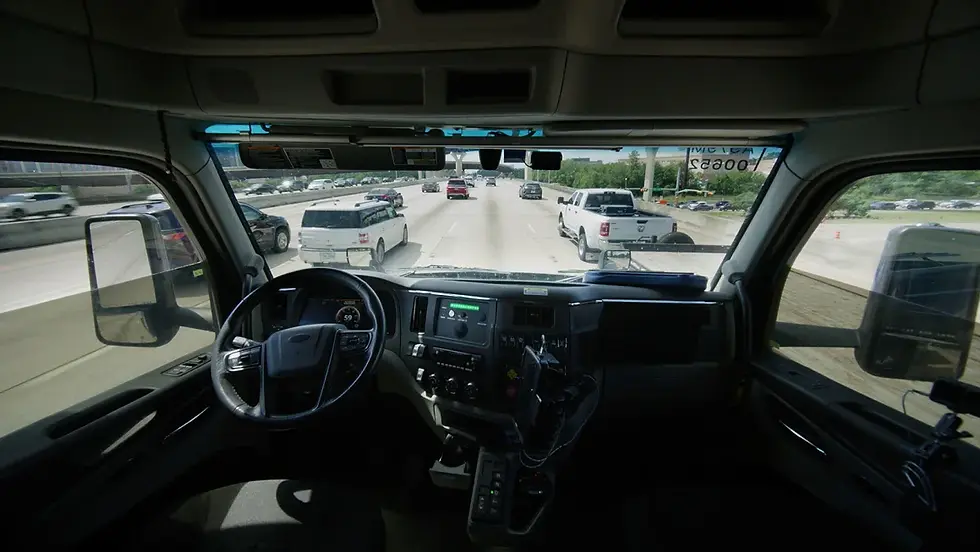
The effect, though, is staggering. It is estimated by the American Trucking Associations that there are more than 3.5 million truck drivers in the United States alone, making it one of the most common jobs in America. The loss of jobs would not just devastate individuals and families, but also communities that make a living off truck stop economies and supply chain work. Trucking is currently one of the most stable vocations for many without a college degree that offers a solid wage and way of upward mobility. Who's to say it even exists in a couple decades?
Artificial intelligence will transform the global workforce by 2050, according to reports by PwC, McKinsey, and the World Economic Forum. Estimates suggest as many as 60% of current jobs will need to undergo dramatic changes due to AI. Automation and intelligent systems will be featured in the workplace. And as the supply of jobs shrinks while the supply of applicants does not—grows—competition will rise. That is, employees must prepare now, or get left behind.
What Fewer Jobs Means for Everyone:
With fewer positions to be obtained, basic economics comes into play: when supply is lower and demand is constant, the value of what remains goes up. In the labor market, that means competition. For job seekers, it's no longer a matter of standing out, but one of survival. As companies look to cut costs and operate more efficiently with AI deployment, many will cut back on hiring or eliminate certain jobs entirely.
Equally, retailing is transforming at a fast pace. At supermarkets, there are self-checkout stations at virtually every supermarket and even cashierless stores by Amazon Fresh and Whole Foods. Some shops are employing computer vision and sensors to monitor purchases and charging customers automatically on their way out, bypassing the requirement of human intervention. Even though these advancements enhance efficiency, they simultaneously render entry-level and low-skilled occupations more difficult to come by.
The consequences of the trend are clear: less work available, especially in repetitive or dull work, equals greater competition for available jobs. A 2024 study by the Institute for Public Policy Research estimated that the share of tasks exposed to generative AI could rise from 11% today to as much as 59% as adoption deepens, with back-office and administrative roles at the highest risk. BlackRock CEO Larry Fink recently revealed that his firm is already employing AI to automate back-office positions. Those types of jobs, which include data entry, form filling, or merely scheduling, are being replaced by software.
The Professional Class is Not Safe Either
White-collar jobs are not exempt from the attacks. Goldman Sachs economists have estimated that generative AI could expose the equivalent of 300 million full-time jobs worldwide to automation. Jobs previously regarded as "safe" due to the fact that they require a college degree or specialized knowledge are now at risk. Accounting, financial modeling, and even data analysis can be at risk. Platforms like Bloomberg's Terminal already use AI to generate financial overviews and reports faster and as accurately than human analysts.
In the practice of law, programs like Harvey and CoCounsel can compile contracts and conduct legal research at lightning-fast speeds and with precision. These tools already handle much of the document review once assigned to entry-level paralegals. While high-end lawyers who argue in court or construct legal strategies are hard to replicate, much of the preparation and research work is already accessible through machines.
Even the medical field, long considered one of the safest of industries, is changing almost overnight. Medical diagnosis computer software can read medical images faster and more accurately than radiologists in some cases. Anyone can input their symptoms into ChatGPT and receive a solid diagnosis(though you should also check with a medical professional). Even Robotic surgery, a pillar of science fiction, is increasingly being performed. Equipment like the Da Vinci Surgical System, with 9,000 systems installed worldwide, allows greater control and almost negligible error-making, with the human surgeon more of a referee than a direct operator. Much of medicine’s administrative work, including billing, scheduling, and even first-pass triage through AI symptom checkers, is increasingly automatable. Not all medical occupations are as vulnerable, though. Occupations based on human-to-human contact and empathy like nursing, therapy, and social work are harder to automate.

Software and Creative Jobs: Enhanced or Replaced?
Artificial intelligence is also disrupting technology and creative industries—but in a more complex way. While AI is able to, on the one hand, enhance productivity levels for software developers and designers, it may also automate low-level functions entirely. GitHub Copilot is already generating code blocks with very little human input.
In arts and design, generative AI tools such as DALL·E and GPT-based models can generate artwork, produce marketing content, and even write news stories. Some businesses are employing AI in composing press releases, logos, and creating advertisements, with minimum or no intervention by humans.
Not All Jobs Are Created Equal
The speed of automation will be uneven. Emotionally intelligent, physically competent occupations or involving high-level interpersonal interaction will persist longer. Teachers, particularly those who work with young children or special subjects like philosophy and ethics, are harder to automate.
Similarly, technical skills like electrical work, plumbing, and car repair require flexibility, on-site problem-solving, and hands-on manipulation in open environments—areas AI and robots still cannot excel. These sectors may even see growth, especially as they become comparatively more secure from the threat of robotics.
Business leadership roles also remain less susceptible to AI. Ethics, uncertainty, planning for the short term and the long term, and motivating individuals to perform are harder to put into data. CEOs like Jamie Dimon of JPMorgan Chase and Bill Ackman of Pershing Square have warned that just as mundane work will be managed by AI, strategic leadership will remain human-driven.
How Does UBI Play a Role?
And then there’s universal basic income (UBI)—an idea that’s moving from fringe theory to a serious policy idea. Popularized politically in the U.S. by Andrew Yang in 2020, UBI has now caught the interest of some of the most powerful figures in AI: Elon Musk and Sam Altman, among others. Their logic? If AI automates away millions of jobs, then people will still need income. UBI, they argue, is the safety net of the inevitable AI age.

On its surface, this may seem so kind of them. If AI makes it harder to find meaningful employment, why not ensure that everyone has a financial floor? Musk claims to envision a future where AI takes care of material needs, leaving humans to explore meaning, creativity, and leisure. Altman has said UBI will be necessary in a world where machines generate massive wealth and replace traditional work. From a utilitarian standpoint, it seems like a win: more comfort, less stress, and no one left behind.
The narrative started to bend, however, when critics pointed out that this generous-sounding proposal might have more to do with protecting AI's unchecked expansion into society. If the creators and owners of these technologies stand to profit enormously, offering UBI could be a preemptive way to buy social peace and secure the legitimacy of AI’s dominance. The logic is simple: as long as people receive just enough—what the Romans called 'bread and circuses'—they won’t rebel, allowing those in power to quietly consolidate control at the top.

Sociologist Pierre Bourdieu’s concept of symbolic violence helps us see this clearly. Symbolic violence happens when dominant groups impose values or systems that everyone starts to accept as “natural” or “inevitable,” even if those systems are designed to keep power in the hands of a few. In this case, UBI may act like a soothing balm on the wound AI inflicts, all while ensuring that the AI elite remains untouchable. You're not poor—you're part of a grand social evolution. You're not disempowered—you’re "freed" from labor.
Even worse, research isn’t confirming the utopian promises. A recent study funded by Altman himself (via OpenResearch) gave 1,000 low-income Americans $1,000 a month. While it helped with groceries and rent, it didn’t lead to transformative gains in health, education, or job quality. In other words, UBI helped people stay afloat, but it didn’t change the tides. But even then, how far does $1,000 a month go when a robot takes your job and you need to pay for rent, groceries, and gas?
This is not to say UBI is inherently bad. It makes sense as a baseline that allows people to take risks, care for family, or seek further education without constant financial anxiety. But tying its legitimacy to AI’s rise is dangerous. It frames the elimination of work as inevitable and normalizes the idea that society must adapt to technology, not the other way around.
Conclusion:
This groundbreaking arrival of artificial intelligence marks a complete transformation in the moral and economic fabric of society. From attorneys to truck drivers, programmers to clerks, there are few professions outside its reach. While AI promises efficiency and convenience, it threatens to untangle the very notion of work as a source of dignity, meaning, and social cohesion. As we stand on the cusp of an era of innovation, we must not only query what AI can do, but who it helps—and at what expense. The question is no longer whether AI will change the world, but whether we shall have the courage to change AI so that it not only saves livelihoods, but way humankind operates.
Sources:


